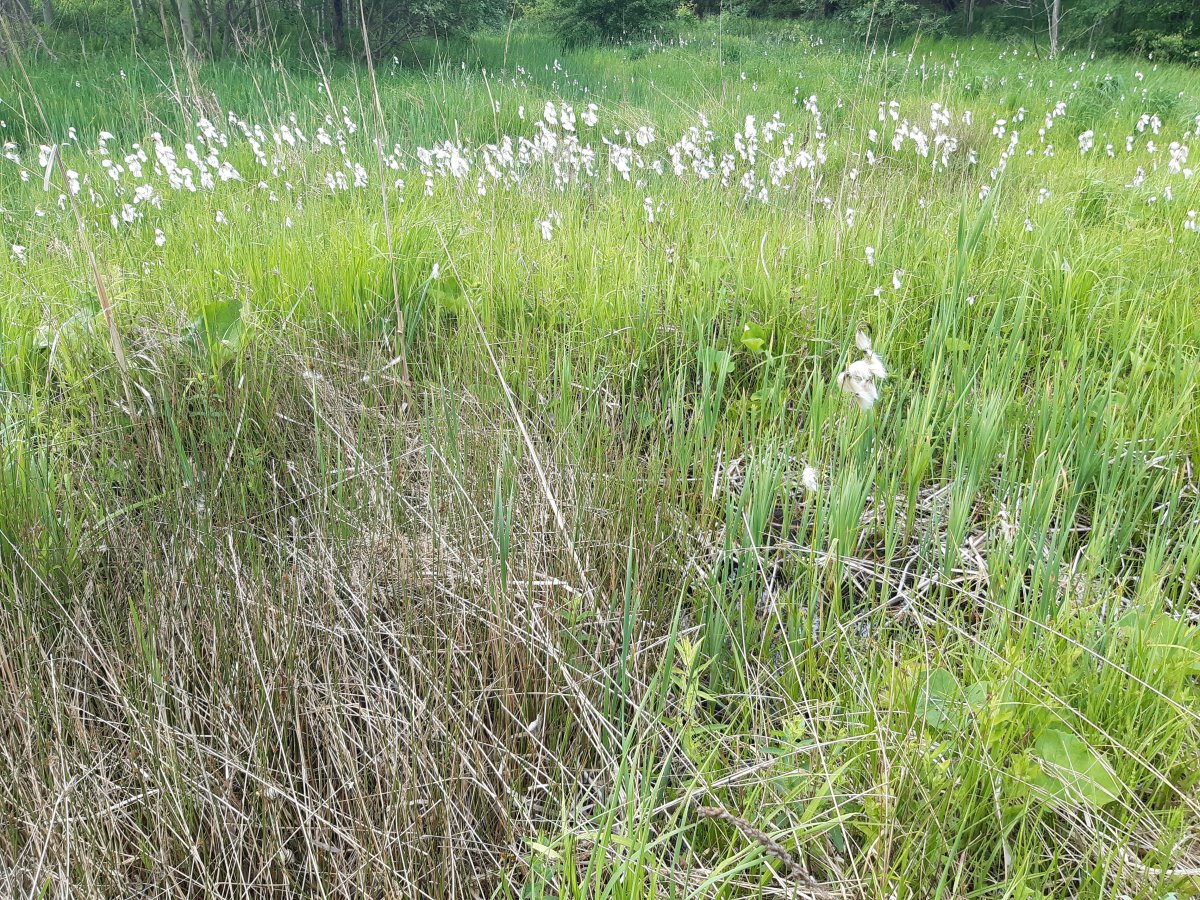
In early July, a hay meadow on a slope above an Alpine village is still standing. The grasses have headed out, the first knapweed and meadow sage are open, and no one has cut yet. A neighboring field mowed in late May shows the alternative: short regrowth, very few flowers, and a sward that reads as grazed rather than harvested. The seed mix is broadly the same. The calendar is not.
What makes these meadows species-rich
These are not wild grasslands. They exist because farms took a hay crop and then grazed the regrowth for generations, and the flora assembled around that rhythm. Dozens of species can share one field, with counts highest where management has been consistent and modest. Most of the herbs are perennials that need a full season to flower, set seed and ripen it. One late cut leaves that window open; a May cut, or three cuts, closes it.
Structure matters as much as the species list. In June the meadow is layered: tussock grasses, taller forbs, low rosettes, and a litter layer that stays cool and damp at ground level. That architecture is habitat. Beetles, spiders, leafhoppers and moth larvae use the thatch and stem bases; bumblebees need a run of flowers into summer; birds such as the whinchat, and in some regions the corncrake, nest in the standing crop. Early or frequent cutting removes seed set and nesting habitat in the same pass, and it scalps the litter layer that overwintering invertebrates depend on.
The mowing date as a management tool
If a manager can change one thing, it is the date of the first cut. Later cutting lets more species complete reproduction, which is why it is the lever most agri-environment programs pull. The trade-off is feed quality: grass that has headed and begun to senesce is stemmier, higher in fiber and lower in protein, so late hay suits dry cows, hardy stock or maintenance rations better than high-yielding dairy animals. Farms therefore stagger parcels, cutting some early for quality and some late for flora, and the balance is set by the livestock enterprise rather than by wildlife alone.
How the cut is made also counts. Mowing from the center outward, or leaving an unmown strip at the field edge, gives insects somewhere to move and keeps a band of flowers standing. A few uncut patches carried through winter provide cover. A complete cut across a whole field on one sunny afternoon is efficient for the farmer and close to a disaster for anything that cannot fly fast.
Dates slip with altitude and weather, and that variation is part of the system too. A farm that cuts its lowest field in June and its highest field in August is running a mosaic in time, so something is always flowering somewhere on the holding. Uniform dates imposed across a whole valley, whether by machine capacity or by a payment schedule, compress that mosaic and make the season shorter for every flower visitor.
Hay, silage, and the difference for insects
Hay and silage are both conserved grass, but the timing differs and so does the ecology. Hay is cut late, dried in the field over several days of sun, and baled at low moisture; by then the crop has usually flowered. Silage is cut earlier, while the grass is leafier and more digestible, wilted briefly, and sealed so that lactic acid bacteria ferment sugars into acid and preserve the crop. Because silage depends less on a long dry spell, it spread readily in wetter, cooler districts, and it usually means two or three cuts a season instead of one.
For insects that is a different regime. Earlier first cuts remove flowers before many bees and butterflies have finished, repeated cuts interrupt the flowering sequence, and fast wilting leaves little standing vegetation. Hay’s single late cut is gentler, though the drying period and the machinery passes carry their own costs. The comparison is not hay good, silage bad; a farm’s conservation value tracks the number of cuts, their timing, and how much refuge is left, whatever the method is called.
Nutrient poverty as a feature
Species richness here is maintained by scarcity. For decades or centuries these fields exported nutrients in hay and returned almost nothing: no bagged fertilizer, little manure, grazing only after the crop was taken. The result is a sward limited by nitrogen and phosphorus, where grasses cannot grow rank enough to smother the forbs. Add phosphorus and the grasses respond first, growing taller and denser, and the herbs drop out within a few seasons. Low phosphorus in particular favors herbs over grasses.
The same logic explains why the meadows are vulnerable to neglect as well as to intensification. Abandonment lets tall grasses and then shrubs close over the sward, and light-demanding flora disappears. Atmospheric nitrogen deposition delivers the same fertilizing effect from the air, which is why some meadows lose species even when the farmer changes nothing. A hay meadow is a managed nutrient-export system, not a piece of land left alone.
Steep ground and the labor problem
Many of these fields sit on slopes that machines cannot safely work. Above roughly a third gradient, a conventional tractor and mower becomes a liability, and on the steepest parcels the work still goes to a scythe or a brushcutter on a harness. Hand mowing in tall grass is slow and hard on the back; a strong worker clears only a fraction of a hectare in a day, and the hay must then be raked, turned, and carried or winched down to a track.
That difficulty is also a kind of protection. Where the ground resists mechanization, the old rhythm survives: one late cut, hay dried on the field, aftermath grazed. Where slopes are gentle enough for machinery and the land is worth improving, the same fields tend to be reseeded and fertilized. The paradox is that this biodiversity is a by-product of awkward terrain and expensive labor, and both are under pressure. Hay income rarely covers the cost, so the meadows persist where payments, part-time farming, local haymaking groups or a cheese and livestock economy support the work.
What gardeners can copy at small scale
A garden lawn can run a version of the same experiment. The essentials are a late first cut, one cut rather than many, and removal of the clippings so nutrients leave the system. A lawn left uncut until late June or July lets daisies, clover, buttercups, selfheal and plantains flower and seed; cutting then with the mower set high and the bag on mimics a hay crop at domestic scale. Raking off the cuttings matters more than most gardeners expect, because leaving them to rot returns the nutrients that keep grasses dominant.
A few refinements help. Leave a strip uncut through winter as refuge, and do not tidy the border before spring, because stem bases and hollow stems are where insects overwinter. Do not fertilize, and do not spread compost over the meadow area. If the surrounding flora is species-poor, the meadow will fill with whatever is already present, so plugs of local-provenance wildflowers may be needed to start the process. The result will not match an Alpine field in species count, and it is not meant to; the timing rules are what carry over.