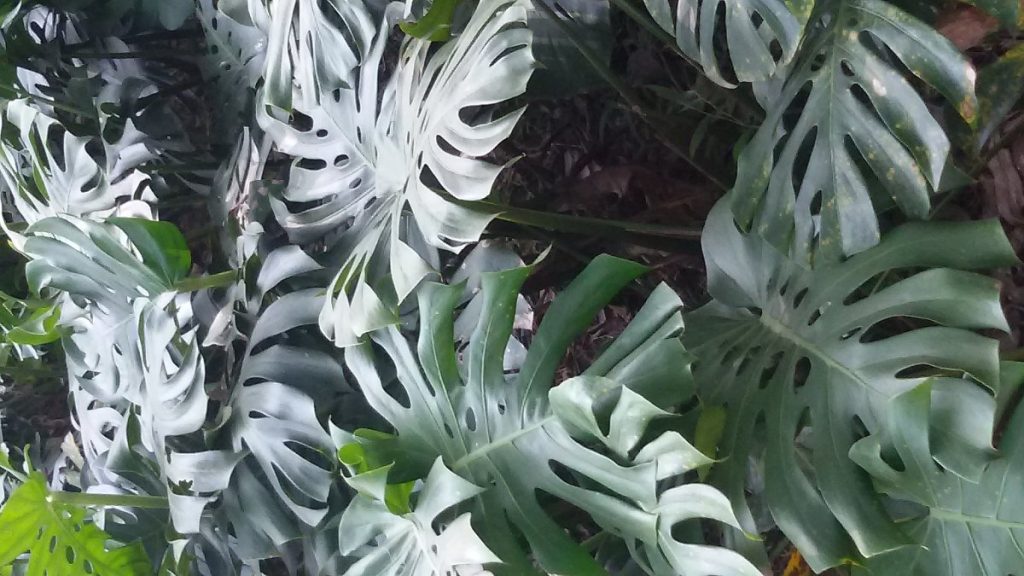
A Monstera that has spent three years in the same corner will usually keep making leaves, just not the ones its owner was hoping for. The new blades unfurl whole, heart-shaped, and modest, and because the plant looks healthy nothing seems wrong. Then a cutting from a friend’s plant, grown on a brighter sill, opens a leaf with two splits and a third forming, and the comparison becomes hard to ignore.
Those splits are called fenestrations, and they are a response to two things: how much light the plant has captured and how mature the stem is. They are not a reward for fertilizer, and no bottle will force them on a plant growing in a dim hallway.
Why your Monstera has no holes yet
Juvenile Monstera deliciosa produces solid leaves for its first several nodes, and that is normal. As the vine climbs and its total leaf area increases, the plant has more energy to spend on each new blade, and the splits begin to appear. In most homes the change happens somewhere between the eighth and fifteenth leaf, but that range is a rough marker rather than a schedule; a plant in strong light may split earlier, and one in shade may never split at all.
Light is the part growers underestimate. A room can read as bright to human eyes because our vision adapts, while the plant at leaf height receives a small fraction of what a windowsill gets. Nitrogen encourages large, soft leaves, so a heavily fed plant in poor light often produces big solid blades that flop on weak stalks. If you want holes, fix the light first and keep feeding moderate.
Light measured at the leaf, not the room
Measure at the height of the newest leaves, not at the ceiling and not at the floor. A light meter gives a number you can compare week to week. In most homes, a spot two to three feet from an unobstructed east window reads roughly 400 to 800 foot-candles on a bright morning, while an interior corner six feet from any window may read under 100. A Monstera grows well in the 400 to 1,000 range and tolerates more when the sun is filtered.
Distance matters more than compass direction. Light falls off quickly with distance from glass, so a plant three feet back from a south window receives a small fraction of what sits on the sill.
Direct midday summer sun through glass can scorch leaves, especially on a west exposure, so aim for several hours of direct morning sun or bright filtered light for the rest of the day. In winter, when daylight drops below ten hours across most of the US and Canada, a full-spectrum lamp placed 10 to 12 inches above the canopy for 10 to 12 hours a day keeps growth moving.
A substrate you can mix by volume
Mix by volume, using the same scoop for every part: three parts coco coir or peat-based potting mix, two parts orchid bark or bark fines, one part perlite, and one part worm castings or sieved compost. That gives a chunky, airy blend that holds moisture without staying saturated.
If you start from a standard potting mix, add roughly one-third perlite and one-third bark by volume; the result should fall apart when you squeeze a handful and feel light rather than muddy.
The reason for all this structure is the root system. Monstera roots are thick and want oxygen between waterings. In a dense mix, the bottom third of the pot can stay wet for weeks while the surface looks dry, and that is where rot starts.
Repot every 18 to 24 months, or when roots circle the drainage holes. Move up only 2 inches in diameter; a small plant in a large pot is the most common way to create a permanently wet root ball.
Watering by pot weight and pot size
A wet-dry cycle is easier to feel than to schedule. Water thoroughly until it runs from the drainage holes, let the pot drain, and then lift it. As the plant drinks, the pot becomes noticeably lighter, and when it feels close to its dry weight it is time to water again.
In a 6-inch pot in a warm room, the top inch or two typically dries within four to seven days in summer, so a full watering every five to seven days is common. A 12-inch pot holds far more soil and dries much more slowly; ten to fourteen days is a realistic summer interval, and three weeks or more is normal in winter. The bigger the pot, the less the surface tells you about the root zone, so check at three to four inches with a finger or a moisture meter.
Root-bound plants dry faster, which surprises people. Roots displace soil, and a dense root mass pulls water quickly, so a plant that needs repotting may demand water every three or four days in summer and then suddenly stay wet for a week after it is moved into fresh mix.
Empty the saucer within half an hour of watering. Standing water wicks back up into the pot and keeps the lower root ball wet.
Aerial roots, moss poles, and the size problem
Aerial roots are not a defect. They anchor the vine to tree trunks and take up moisture from bark and humid air, and a healthy plant pushes them out between leaves. Leave them on. You can tuck them into the soil surface or guide them onto a support.
A moss pole is the practical answer to the size problem. Insert a 3- to 4-foot pole at the back of the pot, tie the main stem with soft twine every 8 to 12 inches, and keep the pole damp rather than misting the leaves. The plant will grip it and start producing larger leaves with more splits.
Indoors, leaves can reach 12 to 18 inches and a happy vine can approach the ceiling within five to eight years. To keep it manageable, cut the main stem just above a node at the height you want; the plant will branch below the cut. Remove no more than a third of the canopy at once.
Stem cuttings: node placement decides everything
A Monstera stem is divided into nodes and internodes. The node is the swollen point where a leaf stalk attaches, usually marked by a ring and a dormant bud; the internode is the smooth section between nodes. Every viable cutting needs at least one node, because that bud is what produces the new vine.
A leaf with a petiole and no node will root in water and then sit there, sometimes for months, without making a stem. Cut 1 to 2 inches below a node, and include an aerial root nub if one is handy. Single-node cuttings usually work; two-node sections are more forgiving.
Root in water changed every three to five days, or in damp sphagnum inside a clear container. In warm conditions, roots appear in two to four weeks. Move the cutting to the aroid mix when roots are 2 to 3 inches long, bury the node just below the surface, and keep the mix lightly moist for the first two weeks.
When leaves yellow or go black at the edge
One yellow lower leaf every few months is normal senescence. Several yellow leaves at once, especially with a sour smell or soft stems, point to a root zone that has stayed wet too long.
Brown or black edges usually come from inconsistent watering, low humidity, or salt buildup. If the margins are crisp and the soil surface has a white crust, flush the pot with several volumes of water and let it drain. Soft black patches that spread across the leaf are different: they suggest infection, and affected tissue should be removed with a clean blade.
Cold damage shows up as dark, papery patches on leaves touching a window. Move the plant a few inches inward before the first hard freeze. If new leaves are small and pale, think light; if they are large, dark, and soft with long gaps between them, think too much nitrogen and too little light.