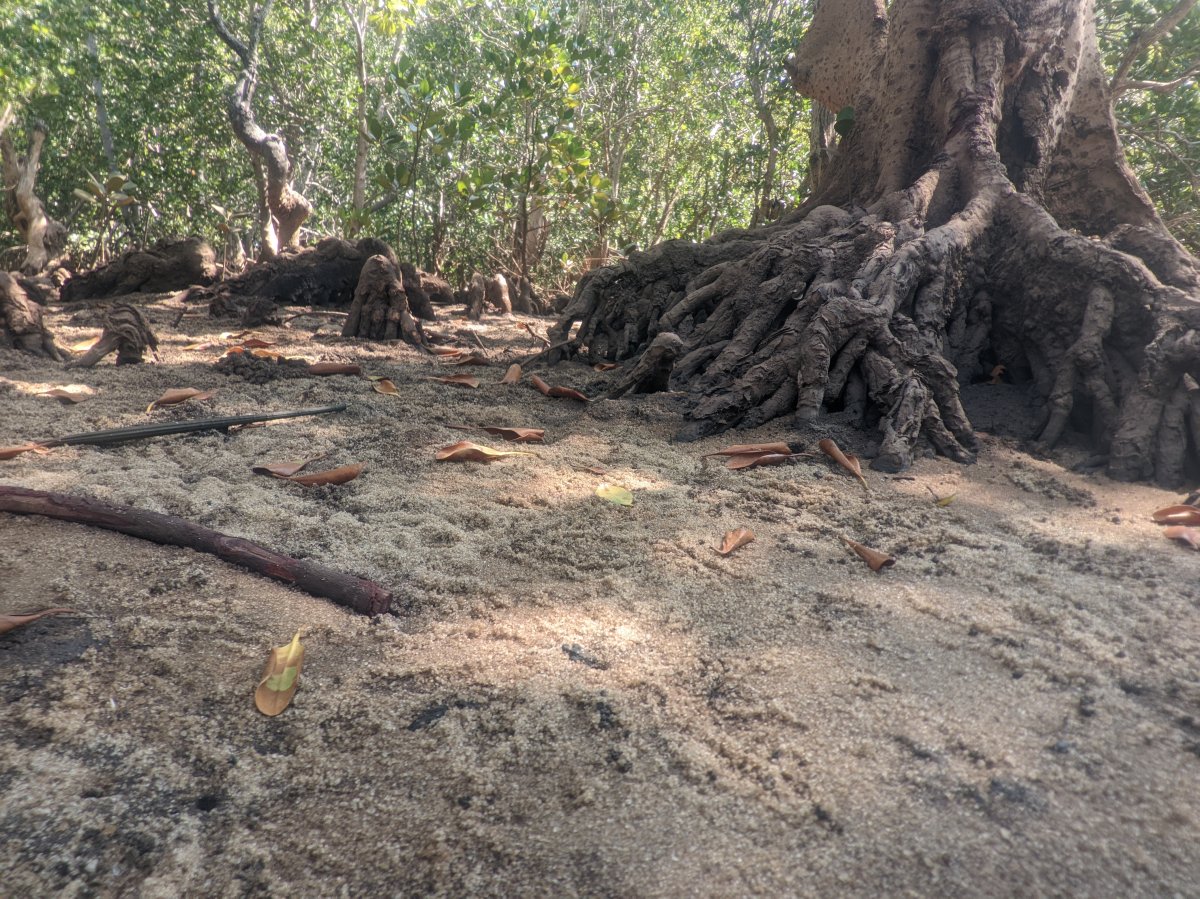
On a coast exposed to typhoons, the difference between a village that floods and one that does not is often measured in the width of the trees in front of it. Mangroves — salt-tolerant trees and shrubs rooted in tidal mud — take energy out of moving water. Trunks, prop roots, and the pencil-like pneumatophores poking through the mud act as a porous barrier, generating drag and turbulence that slow a storm surge and cut wave height. The effect is conditional: a belt a few dozen meters wide will not stop a large surge, and protection depends on offshore bathymetry, water height, and whether the stand is dense or thinned.
Why mangroves are worth the trouble
The waterlogged ground that makes mangroves hard to walk through also makes them a durable carbon store. Saturated mud holds little oxygen, so roots, leaves, and woody debris break down slowly and pile up as peat. Carbon that would otherwise return to the atmosphere within years can stay locked in sediment for centuries. Estimates of how much a given hectare holds vary widely with rainfall, sediment supply, and species, so blue-carbon accounting relies on soil cores, not a single multiplier.
Mangroves also work as nursery habitat. Juvenile fish, shrimp, and crabs use the root zone for cover before moving out to reefs and fishing grounds, which helps explain why coastal fisheries are more productive where mangrove belts remain intact. The roots trap sediment washed off the land, helping to hold shorelines together and, in places, to keep pace with sea-level rise. The stand also supplies crabs, shellfish, fuelwood, and shelter — uses easy to overlook in a project built around one ecological target.
The failure mode: planting without hydrology
Planting is the photogenic part of restoration, and it is where many projects quietly fail. A seedling in the wrong place does not merely grow slowly; it dies, and the money spent on it disappears into the mud. The failures cluster around hydrology: elevation, tidal range, sediment, and how often the site floods.
Mangroves occupy a narrow band between mean sea level and the upper reaches of the tide. Plant below the level a species tolerates and the seedling drowns or is torn out by the first strong tide; plant above the reach of normal tides and it desiccates, with salt crusting the soil around its roots. The tolerable band differs by species and site, and it shifts as sediment compacts, as dikes hold water in or out, and as sea level rises.
Sediment is the second trap. Loose, shifting mud smothers stems, while ground compacted by machinery refuses roots. Abandoned shrimp ponds are especially difficult: many sit behind dikes on ground that has subsided, and the soil can be acid sulfate, releasing acid when it dries and burning fine roots. A pond floor can look like a ready-made restoration site and behave like a hostile one.
Thailand’s record illustrates the pattern. After the shrimp-farming boom of the 1980s and 1990s converted large areas of mangrove to ponds, replanting became the standard response, much of it on the pond floor itself. Where dikes stayed in place and tidal exchange was cut off, sites remained waterlogged, salty, and low in oxygen, and survival was often dismal. Projects that first breached the dikes and reconnected the site to the tide did better, and many found natural regeneration arriving on its own once the hydrology was fixed.
How community tenure changes outcomes
Ask practitioners why one site is still standing after fifteen years and another is a graveyard of bamboo stakes, and the answer often comes down to who controls the land. In Thailand, mangrove areas are governed by a mix of state forest law, marine and coastal management, and local arrangements that vary by province. Where villages hold recognized, long-term use rights and can enforce them, cutting, crab collection, and net fishing tend to follow rules the community sets itself. Those rules are rarely elegant, but they are enforced, because the people enforcing them expect to depend on the stand for years.
Tenure changes the arithmetic. A household with a secure claim has a reason to protect seedlings from livestock, keep out a neighbor’s shrimp pond, and report illegal clearing — and a reason to invest labor in maintenance long after a project’s budget has closed. Reviews of coastal restoration repeatedly identify local involvement and secure access rights as factors separating sites that persist from sites that do not, though the evidence is mostly case-based, and tenure alone guarantees little. Legal recognition is not capacity to enforce; overlapping claims can freeze management; and a community expecting to lose the land to a concession has little reason to plant for the next generation.
Species choice and zonation
A mangrove forest is not one habitat but a gradient. At the seaward edge, Avicennia and Sonneratia tolerate the most flooding and the saltiest water, sending up pneumatophores and excreting salt through their leaves. Behind them, Rhizophora species with arching prop roots and viviparous propagules dominate the mid-zone. Farther inland, where freshwater influence grows, Bruguiera, Ceriops, and Xylocarpus appear, sometimes giving way to a landward fringe of palms.
Planting one species across that gradient is a common mistake. A Rhizophora that thrives at mid-tide will struggle at the seaward edge and may be shaded out inland. Monocultures also tend to be structurally simple: fewer root forms, fewer places for fish and crabs, less resistance to pests and storm damage. Species choice should follow the site’s elevation and inundation pattern, not what the nursery happens to have.
Where hydrology has been restored and a nearby stand survives, natural regeneration is cheaper and more diverse than planting. Propagules can be dibbled directly into mud at a fraction of the cost of nursery stock, but only where the substrate is stable and the tide will not wash them away. On heavily degraded sites, a few hardy nurse species may be needed to stabilize the ground first.
Measuring success beyond seedling counts
Seedling counts make projects look successful on paper and say little about whether a forest is forming. Seedlings are cheap to count, easy to photograph, and frequently dead within two years. Survival at one, three, and five years is a far better measure, reported against the number planted rather than the number that survived the first season.
Beyond survival, canopy cover is the most useful single indicator: it captures whether the stand is closing over and shading out the mudflat, and it can be estimated from permanent plots, drone imagery, or satellite data. Height growth, stem density, and species composition fill in the structure. Sediment accretion shows whether the site is keeping pace with sea-level rise. Soil carbon needs cores, not guesses, and faunal signs — crab burrows, mollusk shells, bird use — reveal whether the root zone functions as habitat. The discipline that separates serious programs from promotional ones is a willingness to publish failures.
What outside funders get wrong
Funders shape projects long before anyone touches a shovel. Payment tied to seedlings planted rewards quantity over placement, and a one- or two-year grant cycle fits the planting season but not the decade a mangrove needs to close its canopy. Maintenance, patrolling, and monitoring continue after the ribbon-cutting, and they are the costs most often left unfunded.
Consultation is another recurring problem. When a community is informed of a project after the site and species have been chosen, it has little reason to defend the result. Free, prior, and informed consent is not a formality; it is how local knowledge about tides, creeks, and grazing pressure enters the design. Carbon finance adds distortion when credits are claimed on area planted rather than carbon actually accumulated, and when the rights of people who use the stand are an afterthought.
A package that works tends to look unglamorous: money for a hydrologic survey before planting, for dike removal where needed, for a local nursery and trained planters, for several years of patrolling at local wages, and for monitoring that runs long enough to catch failure. It also needs an exit strategy that leaves the stand, and the rules governing it, with the people who live beside it.