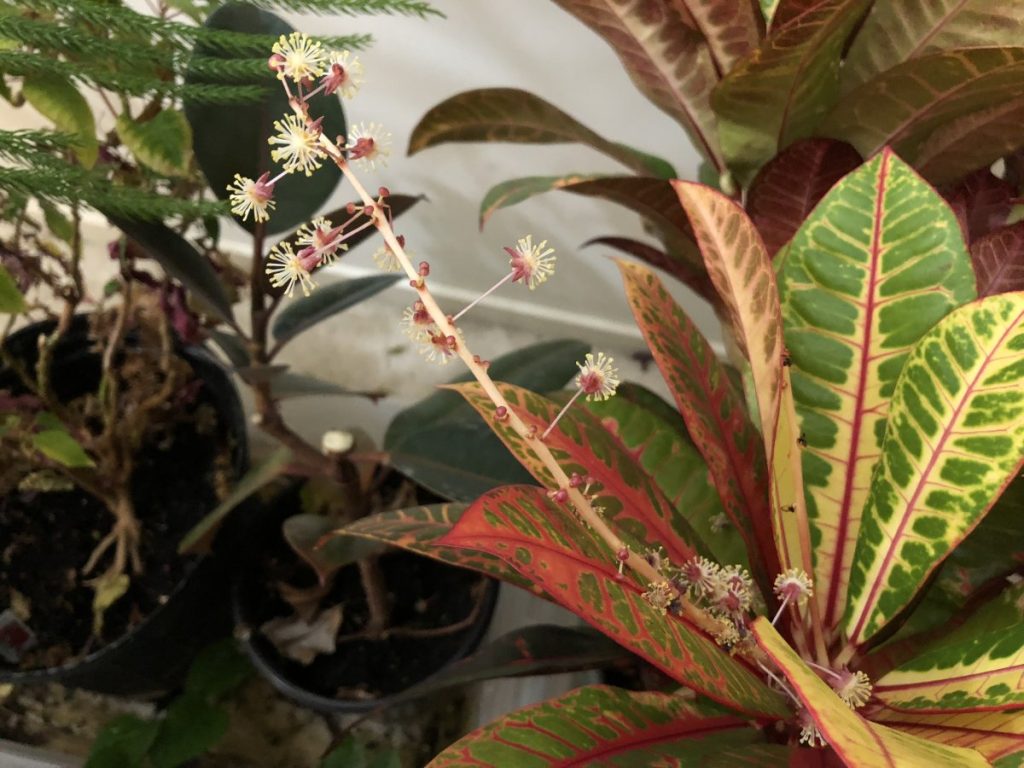
At dusk a healthy calathea lifts its leaves until they nearly meet above the pot, then lets them fall open again by morning. When that movement stops for several nights, the plant is usually reporting on water or air quality well before it shows a single brown edge.
Two plants, one humidity problem
Calatheas and marantas are close relatives in the family Marantaceae, and indoors they fail in the same way: a thin brown margin that starts at the leaf tip and runs along the sides, often with a narrow yellow band between dead and living tissue. Several calatheas have been reclassified into the genus Goeppertia, but growers still sell them under the old name, and the care is the same.
Two causes account for most crisp edges: air that is too dry, and water carrying minerals the plant cannot use. A third cause, root damage from a mix that stays saturated, produces a similar margin but usually arrives with yellowing lower leaves and a plant that stays wilted after watering. Distinguishing them matters, because adding humidity to a plant with rotting roots makes the rot worse.
Most homes run 30 to 45 percent relative humidity in winter, and these plants look best somewhere around 50 to 60 percent. That is a target rather than a requirement, and a plant can adapt to slightly drier air if it is otherwise well grown. A sealed terrarium is not necessary, and most living-room calatheas resent the stagnant air of one.
Water quality and leaf edge damage
Tap water is not one thing. Hard water carries calcium and magnesium, many municipal supplies add fluoride, and softened water swaps the hardness minerals for sodium. Marantaceae have a long reputation for tip burn from fluoride and from soluble salts, though the evidence is uneven: some growers see damage at low concentrations, others grow the same species on tap water for years without a mark. The practical reading is that water quality is one of the cheapest variables to control, so control it before blaming the plant.
A pitcher filter removes chlorine and some sediment but not fluoride or most dissolved minerals; it is not a demineralizer. Letting tap water stand overnight removes chlorine, not fluoride or calcium. Rainwater, distilled water, or reverse-osmosis water is the reliable route, and room-temperature water is gentler on fine roots than cold.
Switch water sources for two months before judging the result. The edges that are already brown will not heal, so watch the leaves that unfurl after the change. If new leaves come in clean, the water was part of the problem. Flush the pot every three months with several volumes of the same low-mineral water to move accumulated salts out of the mix.
Light that avoids bleaching
These plants want bright light without direct sun on the leaves. A north or east window, or a south or west window behind a sheer curtain, usually lands in a workable range of roughly 200 to 500 foot-candles at leaf height. Direct afternoon sun through glass can bleach the patterned surface, leaving pale, washed-out patches that never regain color.
Too little light produces the opposite failure: slow growth, small new leaves, and a pattern that fades toward plain green. The plant survives, which is why the problem goes unnoticed for months. New leaves that unfurl pale and thin are a sign the plant is growing in dim conditions, not a sign that it needs more water.
Rotate the pot a quarter turn each week. Calatheas lean hard toward light, and a plant left in one position develops a lopsided crown that is difficult to correct later. Once you find a spot that works, adjust the curtain rather than moving the plant; every move costs it a few weeks of adjustment.
Soil that holds moisture without going sour
The mix needs to stay evenly damp without staying saturated. A workable blend is roughly half peat or coir, a third perlite or pumice, and the rest orchid bark or leaf mold. That holds water at the roots while leaving enough air space for them to breathe.
A mix that stays wet goes sour: anaerobic, smelling of sulfur or rotten eggs, with a dark, slimy surface. Roots in that mix die back, and the leaf edges crisp even though the soil is wet, which is the confusing part. If the pot smells bad, repot rather than simply watering less.
Use a container with a drainage hole. A decorative cachepot is fine as long as the nursery pot is lifted out to water and never left standing in the runoff. Terracotta dries faster than plastic, so a calathea in a dry room usually does better in plastic or glazed ceramic, where moisture is held more evenly. Repot every 18 to 24 months in spring, into a pot one size larger, and fill the mix loosely rather than compacting it.
Why leaves stop folding at night
The movement comes from a pulvinus, a thickened joint at the base of each leaf and leaflet. Cells on one side lose water and shrink while the other side stays firm, and the leaf swings up at dusk and down again at dawn. The rhythm is internal, which is why it continues for a while even in constant light before fading.
Folding stops when the plant is stressed: dry soil, cold roots, root rot, mite damage, or a sudden move. A plant that has not folded for a week is worth a careful look at the soil and the undersides of the leaves, though it is not a diagnosis on its own. Older leaves move less than young ones, and some cultivars are simply less dramatic than others.
Use the movement as one signal among several rather than as a test. A calathea that folds every night but still shows crisp edges has a humidity or water-quality problem; one that has stopped folding and looks dull is more likely dealing with roots or mites.
Spider mites on the undersides
Spider mites are the common secondary problem on these plants in dry indoor air. They feed on the underside, causing pale stippling that looks like dust, then fine webbing around the leaf base and along the midrib. By the time the webbing is obvious, the population is large.
Check three or four leaves with a flashlight, looking at the undersides rather than the tops. Mites are small enough that the damage is easier to see than the insect. Rinse the plant in a shower with the leaves turned underside-up, and repeat every five to seven days for three weeks to interrupt the cycle. Raise the humidity around the plant, since mites do better in dry air.
If you use a miticide, follow the label exactly. Some products damage thin leaves, and repeated use of the same active ingredient selects for resistance. Isolate the plant while you treat it; mites move to neighboring plants easily, and a calathea beside an infested one is usually the next to show stippling.