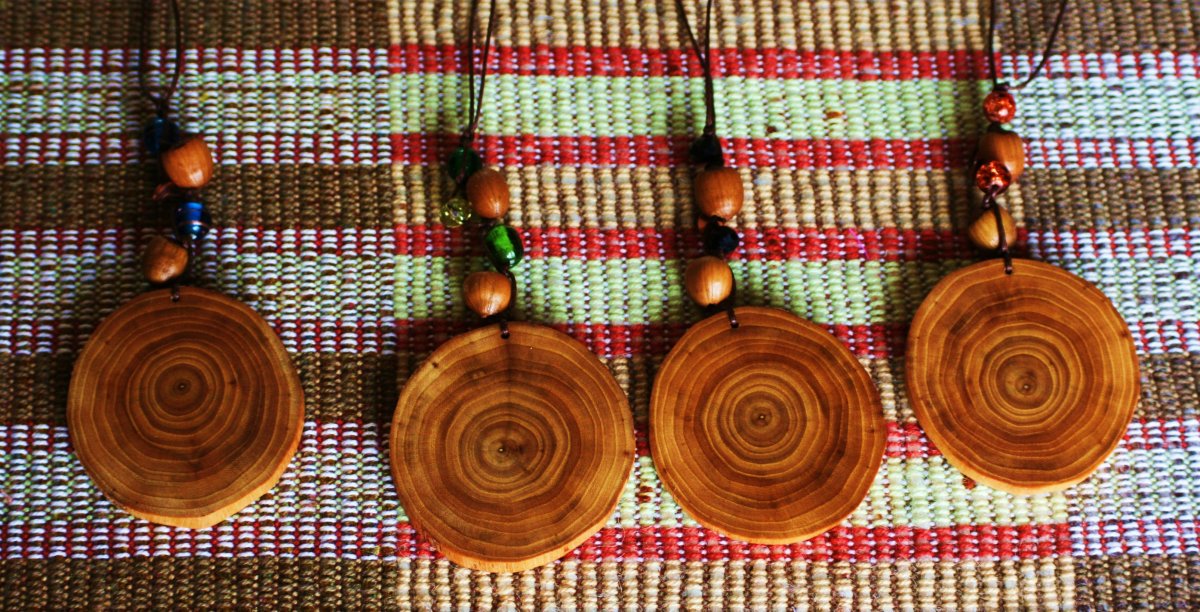
A sharpened plane iron will still fight olive. The shaving starts clean, then goes fuzzy where the grain turns back on itself, and the surface comes up bruised rather than cut. In workshops around Bethlehem and other West Bank towns where ouds, lutes, and guitar-family instruments are built from olive, that reversal is not a flaw to sand away. It is the constraint that decides which part a board can become.
Why olive wood is hard to work
Olive (Olea europaea) is among the densest woods of the Mediterranean basin. Air-dry density varies with site, age, and how slowly the tree grew, but it commonly lands at or above 0.85 grams per cubic centimeter, heavier than most European oak and well above maple. That mass ends up in the neck and back of a finished instrument.
Hardness is not only a matter of density. Olive draws grit into its tissue from stony hillside soils, and that mineral load dulls an edge faster than the wood’s weight alone would predict. The grain in olive does not run straight for long; fibers spiral and cross, which is what produces the wood’s shifting figure and what makes a cutting edge lift and tear the surface instead of slicing it.
Then there is movement. Olive is prone to checking, the splits that open along the grain when the outside of a piece dries faster than the inside. Green olive can lose water from exposed end grain many times faster than through the side grain, and the resulting gradient sets up tension the wood relieves by cracking.
Finally, the blanks are small. Orchard olives are pruned hard and rarely grow the long, straight, clear boles that furniture woods come from. Trunks are short, branchy, and full of old pruning wounds, bark inclusions, and pockets of decay. Instrument makers therefore work in short lengths and narrow widths, and almost every plate, rib, and neck is built from several pieces rather than one.
Seasoning before the first cut
Because the checks start at the ends, seasoning begins there. Cut faces are sealed as soon as the saw stops, usually with a wax emulsion, paraffin, or a heavy coat of leftover paint. The seal does not stop drying; it slows the end grain to something closer to the rate of the sides, so the moisture gradient stays gentle.
Air drying is the standard route. Stock is stacked with stickers between the boards so air can move, roofed against rain and sun, and left in moving but not violent airflow. The old workshop rule of a year per inch of thickness is a rough guide, not a schedule; dense olive commonly needs longer. Kilns can shorten the wait, but schedules developed for softer hardwoods do not transfer safely, and a charge pushed too fast can case-harden, setting the outside while the core stays wet.
For instruments destined for heated North American homes, the target is equilibrium with indoor air, roughly six to eight percent moisture content depending on climate and season. Wood brought into the shop wetter than that and built into an instrument will shrink after delivery, and the joints take the strain.
Grain direction and why it decides the shape
The interlocked grain that gives olive its figure is the same grain that tears. Run a plane the wrong way over a reversing patch and the fibers lift ahead of the edge, leaving a torn hollow that sanding will not flatten without dishing the surface around it. Makers read the grain before every pass, work in the direction that keeps the shaving bright, and switch to a high-angle plane or a cabinet scraper where the direction reverses within a single stroke.
Grain also governs layout. A neck needs continuous, straight fiber from end to end; a blank with runout will snap at the heel or creep under string tension. Because olive rarely offers that length, necks are often laminated from shorter pieces, with joints staggered and grain aligned. Backs may be bookmatched from two halves, or built from three or four narrower pieces when a wide blank cannot be found.
Orientation matters as much as direction. Quarter-sawn faces, where the growth rings stand near perpendicular to the surface, move less across their width and hold their shape better than flat-sawn ones.
Joints that survive dry air
An instrument built in a humid workshop and shipped into a heated house in January meets air at twenty to thirty percent relative humidity. Olive shrinks noticeably across the grain as it gives up moisture, and every cross-grain glue joint becomes a small tug of war. Wide panels shrink; the braces and linings glued across them do not. Something has to give, usually the glue line or the plate beside it.
Good practice is to keep cross-grain members narrow, to orient adjoining pieces so their movement works in the same direction rather than against itself, and to avoid trapping a panel between two rigid crosspieces. Where a brace must cross a wide plate, gluing it only in the middle or letting its ends float in a slot gives the plate somewhere to go. Hide glue helps for a different reason: it is rigid but reversible, so a joint that does fail can be opened and remade without destroying the surrounding wood, which is not true of every modern adhesive.
Finishing without sealing the wood shut
Olive keeps exchanging moisture with the air after the instrument is finished, and a finish that blocks that exchange creates its own problems. Thick film finishes, built up in many coats of polyurethane or heavy lacquer, can look glossy and then crack along glue lines as the wood beneath them moves, trapping moisture where it does the most harm.
Oils and waxes behave differently. A penetrating oil, applied thin and worked into the surface, slows moisture uptake without pretending to stop it, and wax over the top adds resistance while staying repairable. Thin shellac sits between the two: enough build to bring up the figure, thin enough to move with the wood. The trade-off is maintenance: an oiled instrument needs recoating at intervals that depend on use and climate.
Surface preparation matters more than the product. Sanding crushes and burnishes the interlocked fibers, especially at the reversals, and can leave a surface that looks smooth but refuses finish evenly. A scraped surface cuts the fibers clean, takes oil more uniformly, and shows less of the muddying that sanding dust produces in open pores.
Sourcing and the pruning reality
Most olive wood reaching a workshop is not felled timber. Orchards are pruned on a cycle, and the removed branches, crotches, and trunk sections are the raw material of the carving and instrument trades. Dead and storm-damaged trees, and trees removed when groves are replanted or lost to disease, supply larger pieces. Felling a productive tree for its wood is unusual, which is why big, clear olive boards are scarce and why most instrument stock arrives as short, thick, irregular pieces.
That has practical consequences for buying. A maker needs more stock than the job strictly requires, because hidden defects appear only after the first cuts: bark inclusions, old wound pockets, shake, and insect galleries are common. Where possible, the blank is cut oversize, sealed, and left to settle before it is trusted.
Shipping rules deserve a check rather than an assumption. Olea europaea is not listed in the CITES appendices, but national plant-health requirements for untreated wood vary, and small parcels of craft stock can fall under rules written for commercial timber. A maker importing blanks should confirm current requirements with the receiving country’s plant protection service before ordering.
None of this makes olive an easy wood. It is heavy, abrasive, unstable while drying, and unwilling to be cut against its will. What it offers in return is density that carries sound, figure that no stain can imitate, and a supply stream tied to the care of orchards rather than the clearing of forests. Working it well is mostly a matter of respecting the order of operations: dry it slowly, read the grain, design around movement, and let the finish breathe.
Sources
- UNESCO Intangible Cultural Heritage: craft traditions and know-how transmitted within communities.
- FAO Globally Important Agricultural Heritage Systems: olive agroecosystems and orchard management.
- World Intellectual Property Organization: traditional craftsmanship and geographical indications resources.